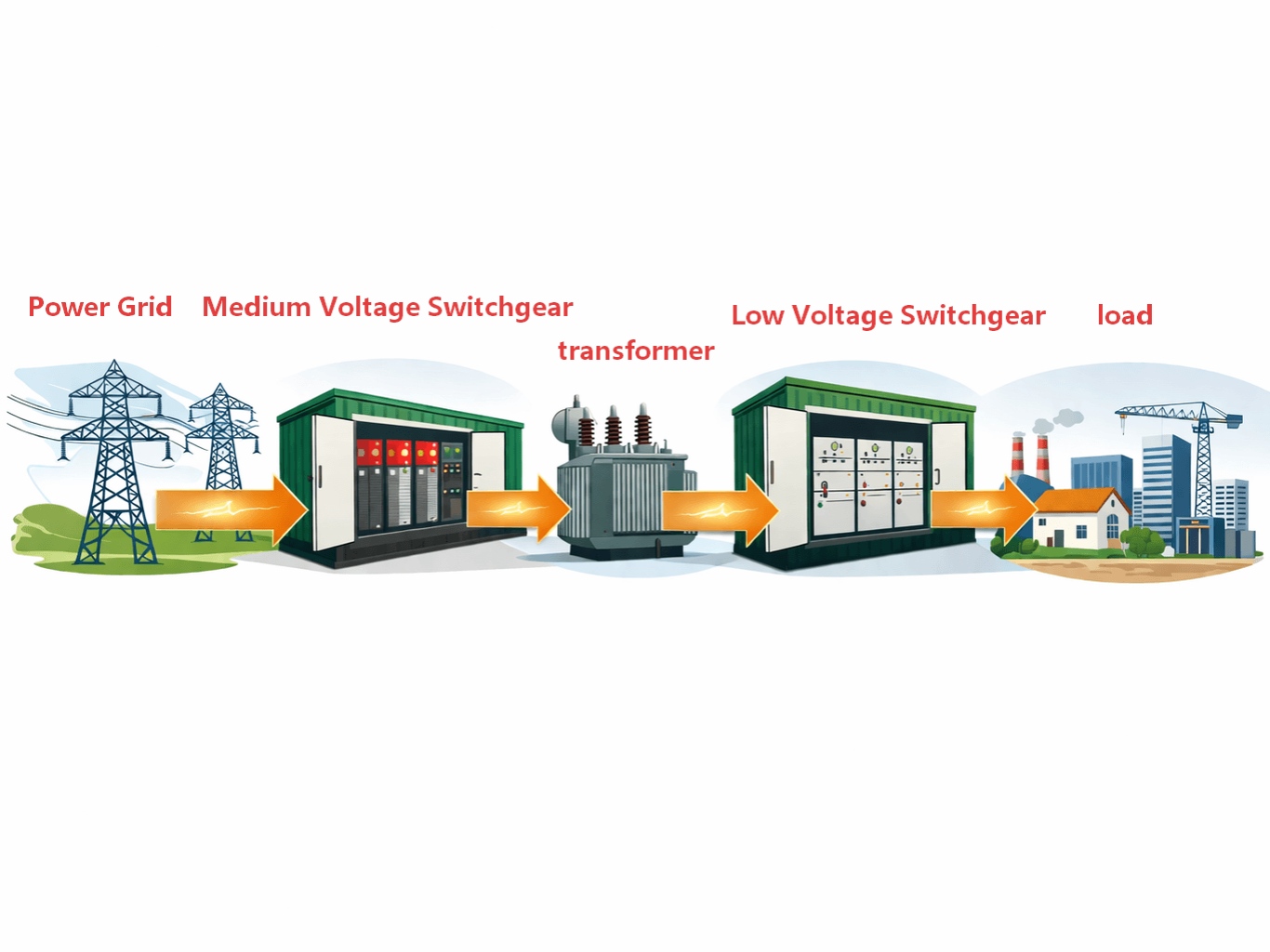

The operating principle of a prefabricated substation essentially involves receiving high-voltage electricity from the power grid—typically at 10kV or 35kV—and, through a process of reception, control, voltage step-down, and distribution, safely and stably converting it into low-voltage electricity suitable for end-user consumption. Throughout this entire process, the reliability of operations is safeguarded by integrated protection and monitoring systems.
High-voltage power from the grid is first routed into the substation’s internal medium-voltage (MV) switchgear. This switchgear manages the intake of external electrical energy and controls the switching (connection and disconnection) of power lines. Simultaneously, in the event of anomalies such as overloads or short circuits, it reacts rapidly to isolate faults and provide primary protection, thereby serving as the critical first line of defense for the incoming power supply.
Following control and protection on the medium-voltage side, the electrical energy is directed into a transformer for voltage conversion. Here, the higher voltage level is stepped down to a low-voltage level—typically 380V or 400V—to directly meet the operational requirements of various equipment and diverse electrical applications.
Once the voltage step-down is complete, the low-voltage electricity enters the low-voltage distribution system. Based on the specific requirements of different zones and load demands, power is intelligently allocated and distributed to production machinery, building electrical systems, lighting, and other control loads, thereby ensuring an orderly and consistent power supply.
Throughout this entire sequence, the substation’s integrated monitoring and relay protection systems continuously monitor key operational parameters—including voltage, current, load levels, and temperature—in real time. Should any anomalies be detected, the system automatically triggers protective actions; furthermore, it supports remote status monitoring and control capabilities, ensuring that the entire power transformation process remains in a state that is consistently safe, stable, and fully supervisable.
Its defining feature is “pre-assembled”: all internal connections, commissioning, and testing are completed at the factory before the equipment arrives on site. Once delivered, you only need to complete basic installation, connect external cables, and perform minimal commissioning. This allows for rapid deployment, essentially providing your project with a plug-and-play “power module.”