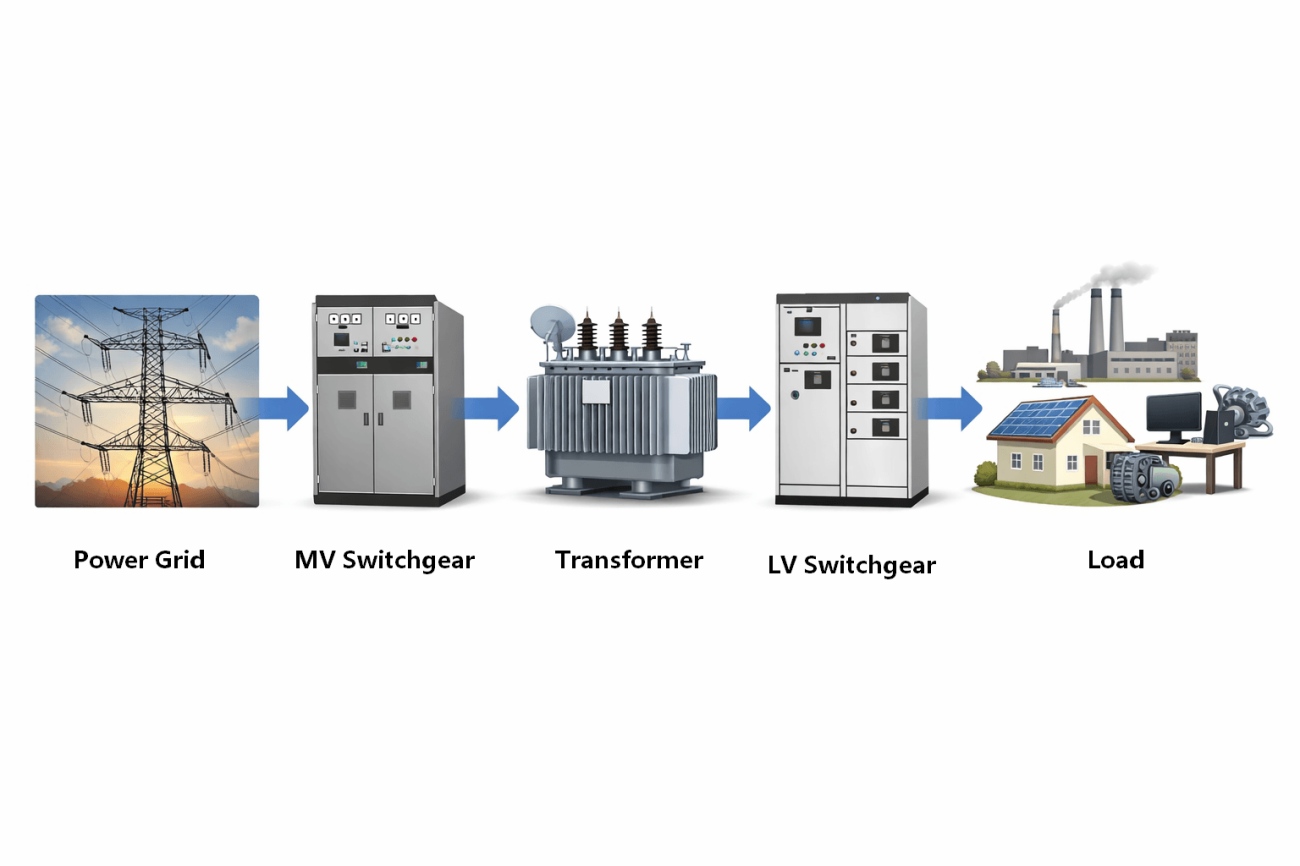

The containerized substation functions as a self-contained, integrated power conversion unit, operating via a straightforward process. Upon connection to the utility grid, incoming power first passes through the medium-voltage switchgear housed within the container. This switchgear is responsible for connecting and disconnecting circuits; additionally, it incorporates fault protection capabilities to facilitate the preliminary control and distribution of the incoming electrical energy. Subsequently, the power is routed to the built-in power transformer, where voltage conversion is achieved through the principle of electromagnetic induction—stepping down the higher-voltage input to the lower voltage level specifically required by the on-site loads. Following this step-down process, the low-voltage power enters the low-voltage distribution section, where it is channeled through components such as circuit breakers and busbars to be distributed, circuit by circuit, to the various downstream power supply lines.
Throughout this entire operational cycle, the accompanying control and protection system continuously monitors critical parameters such as voltage, current, and temperature. Should any anomalies—such as overloads, short circuits, or undervoltage conditions—arise, the system responds immediately to isolate the faulty circuit, thereby safeguarding the integrity of both the equipment and the power lines. Ultimately, a stable supply of low-voltage electrical energy is delivered to power the end-user loads.