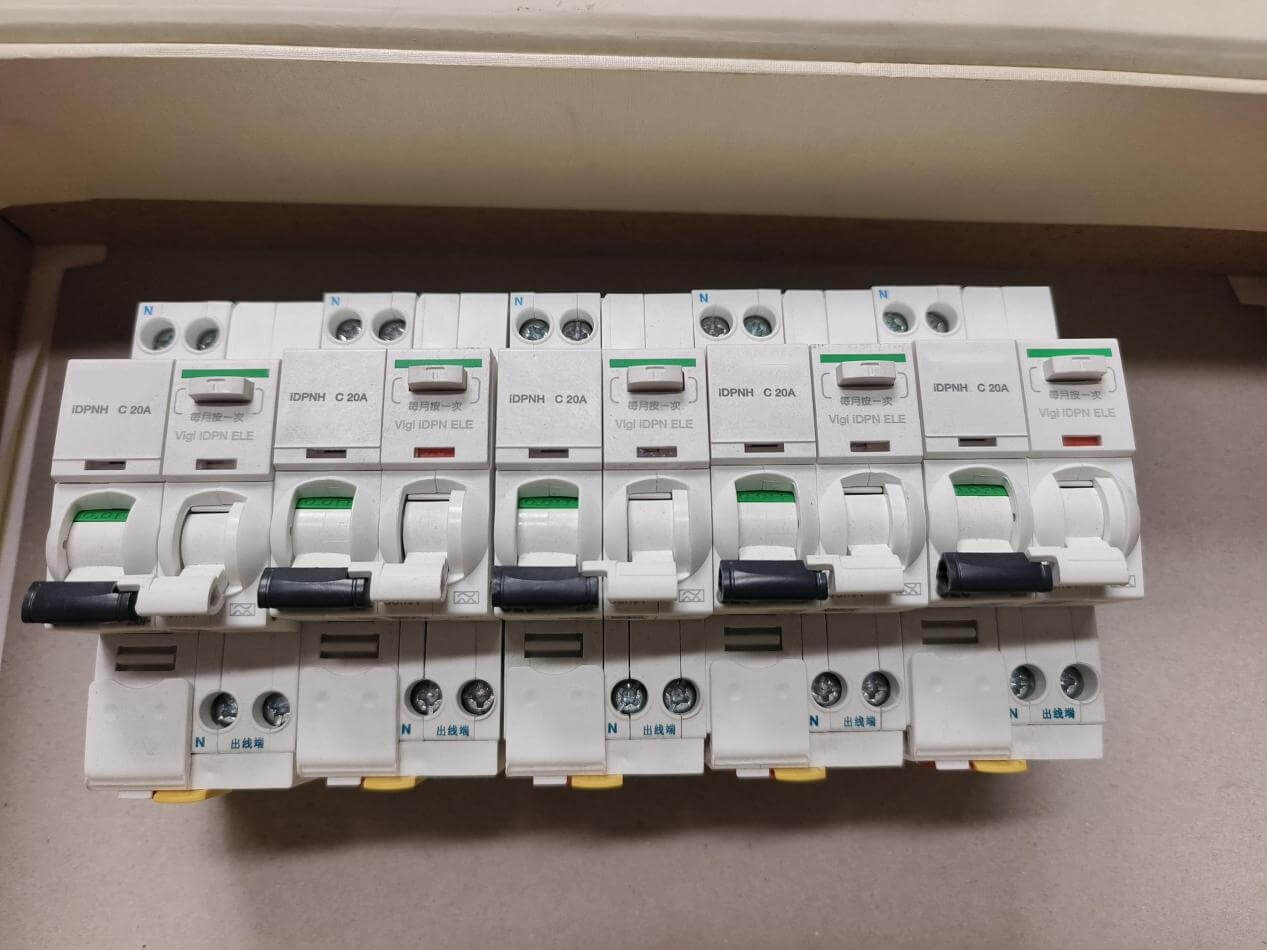

So, how exactly does this miniature circuit breaker manage to achieve the feat of being able to withstand momentary surges while instantly responding to danger? Many people know only that it trips, yet remain unclear about the underlying logic behind its operation. Below, we will break down its working principles step by step to see how this little guardian of electrical safety delivers such sensitive yet reliable protection.
1. Normal Operation
During normal power use, the current flows smoothly through the circuit breaker, and the internal contacts remain closed and conductive, ensuring a continuous circuit. At this time, the circuit breaker functions like a regular switch, simply allowing current to flow smoothly without tripping unnecessarily, ensuring the normal operation of appliances and wiring.
2. Overload Protection — Thermal Mechanism
When the current in the circuit exceeds the rated operating range of the circuit breaker for a sustained period, an overload occurs. The excessive current causes the bimetallic strip inside the circuit breaker to gradually heat up. As the temperature rises, the two metals with different coefficients of thermal expansion undergo uneven deformation, slowly bending to one side. When the bending reaches a critical point, it directly triggers the internal tripping mechanism. This ultimately causes the contacts to open rapidly, completely cutting off the circuit and protecting the wiring and appliances from overheating damage.
3. Short Circuit Protection — Magnetic Mechanism
Once a short circuit occurs, a huge current far exceeding the normal range will surge instantaneously. This extremely strong current will immediately flow through the electromagnetic coil inside the circuit breaker, rapidly forming a powerful magnetic field around the coil. Under the influence of the magnetic force, the internal iron core will be instantly attracted and rapidly pushed, directly causing the tripping mechanism to act instantaneously, completing the power-off protection almost in a split second.
4. Arc Extinction
At the moment the contacts open, the strong current in the circuit does not disappear immediately, often leaving a bright electric arc between the breaks. This arc is very hot, and if left unattended, it can easily burn out components or even cause danger. The circuit breaker has a specially designed arc-extinguishing grid structure that quickly guides the arc in, breaking it into multiple small arc segments, and continuously cooling it until the arc is completely extinguished, ensuring the circuit is completely disconnected and safe.
5. Trip and Reset
After the circuit breaker completes its trip protection, the operating handle will clearly remain in the open position, making it easy to see that the circuit has been disconnected. After you have troubleshooted and resolved previous overloads, short circuits, and other faults, and confirmed that the lines and appliances are back to normal, you only need to manually push the handle back to the closed position to reconnect the circuit and restore normal power supply.