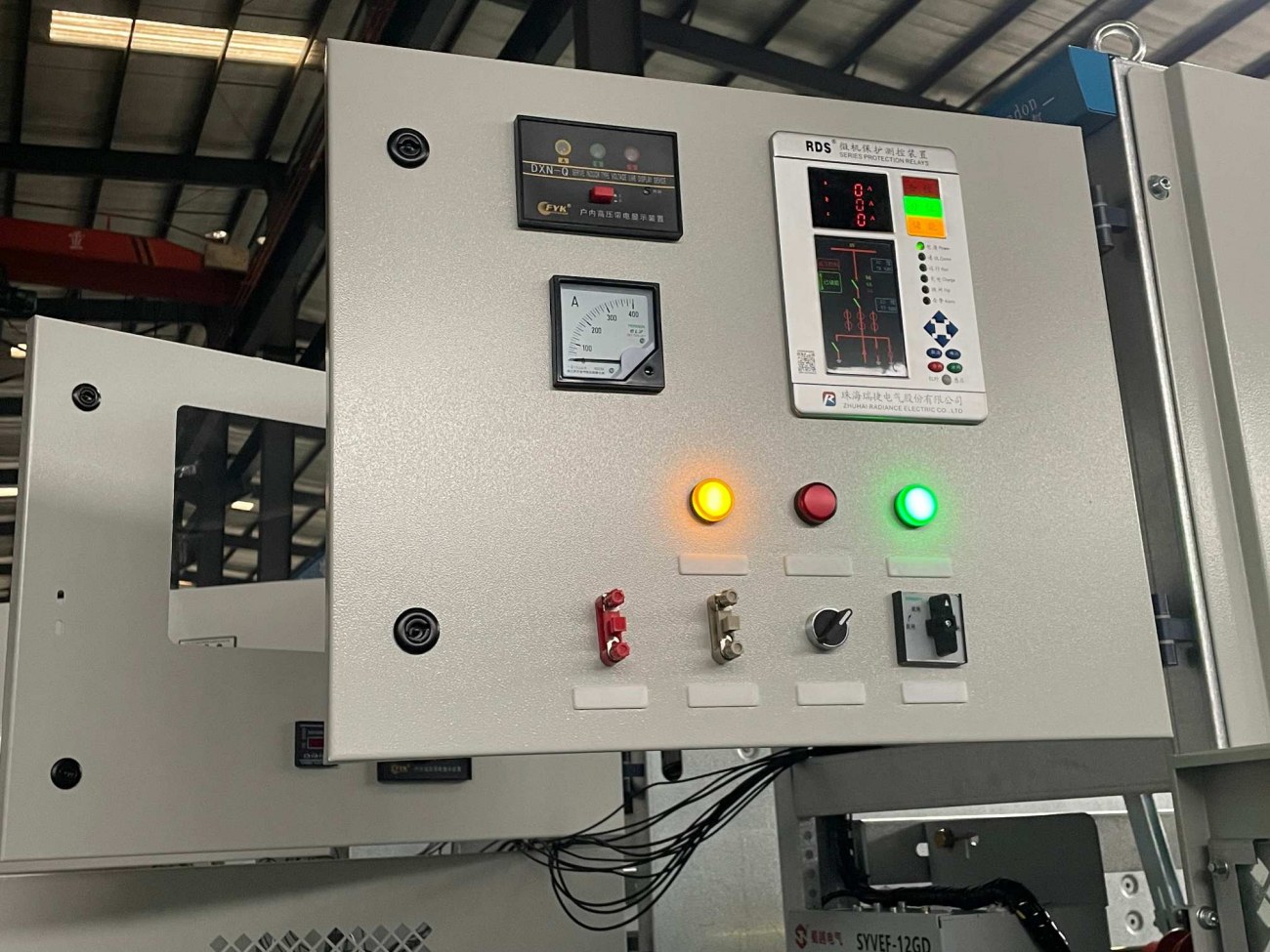

Understand the working principle of medium voltage switchgear and how it safely controls, interrupts, and isolates current.
During normal operation, the medium voltage switchgear is in a closed state, with internal conductors forming a complete loop, and current flows smoothly from the input end to the output end. In terms of design, this stable operating state typically relies on the precise design of the internal circuit breaker and the conductive system, ensuring stable contact pressure and reducing resistance and heat generation.
When it needs to be disconnected or a fault occurs, the protection mechanism triggers immediately, causing the switch contacts to separate quickly and cut off the circuit. This action must be fast enough to reduce damage to the equipment.
An arc will be generated at the moment of disconnection, which is a normal phenomenon. The equipment uses special structures to stretch the arc and guide it into an arc chute, then cools and extinguishes it with insulating materials or media, ensuring the circuit is completely disconnected.
The final step is isolation. After the contacts separate, a physical gap visible to the naked eye is formed, ensuring that current absolutely cannot pass through and that it will not accidentally reconnect.