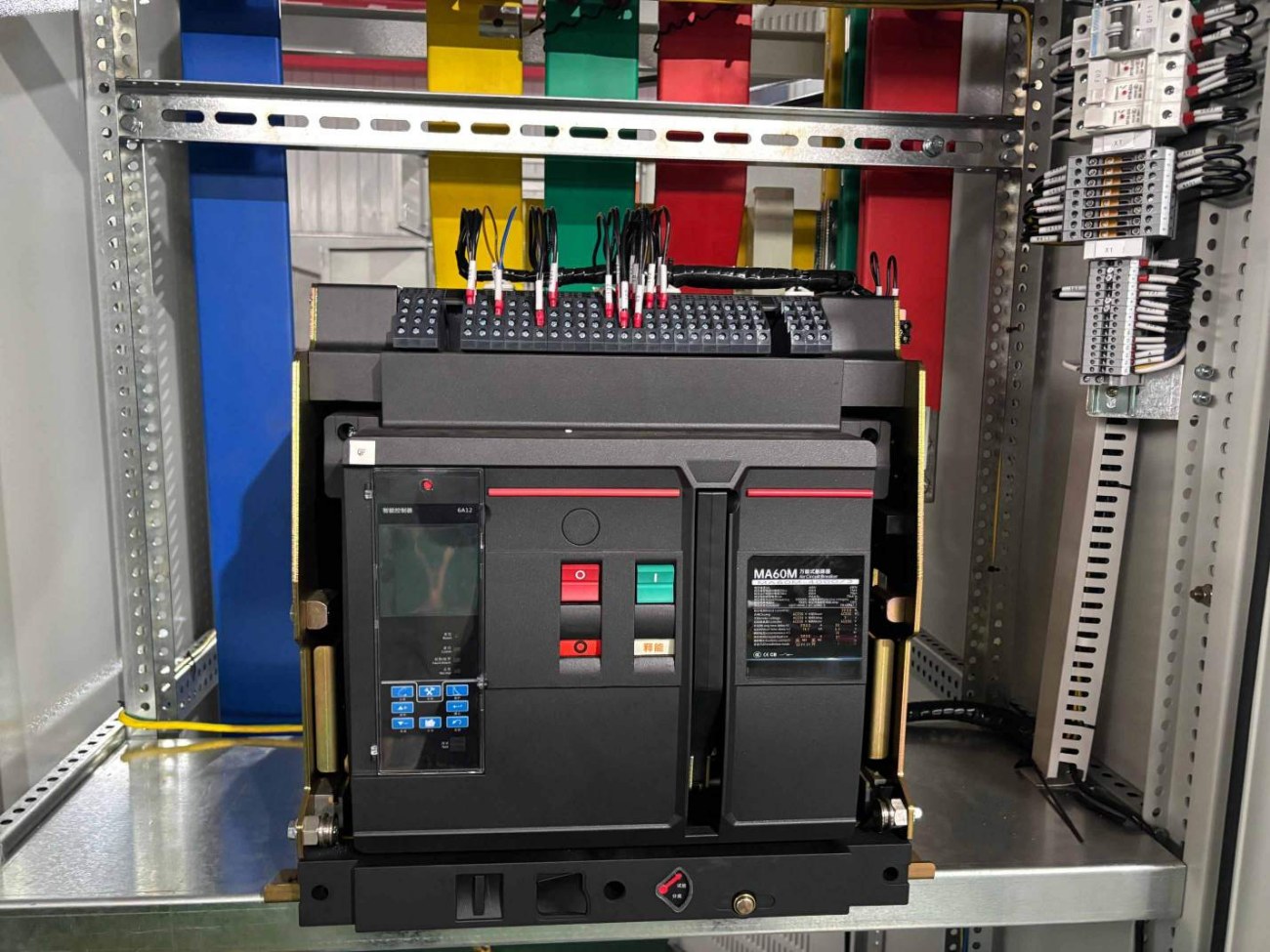

An air circuit breaker detects faults, trips automatically, extinguishes arcs, and safely interrupts circuits to protect equipment.
Under normal operating conditions, the contacts remain closed, allowing current to flow smoothly through the air circuit breaker and continuously supply power to the load.
When circuit faults—such as overloads or short circuits—occur, causing the current or voltage to exceed normal limits, the air circuit breaker’s tripping mechanism detects this anomaly in real time. As soon as the parameters exceed their preset thresholds, the thermal-magnetic or electronic trip unit activates immediately, driving the operating mechanism to actuate rapidly and cause the main contacts to separate swiftly. An electric arc is generated at the instant the contacts open; this arc immediately enters the arc extinguishing chamber, where, aided by the air medium, it is continuously elongated, segmented, and rapidly cooled until it is completely extinguished. Consequently, the circuit is fully interrupted, thereby providing protection for both the power lines and the connected equipment.