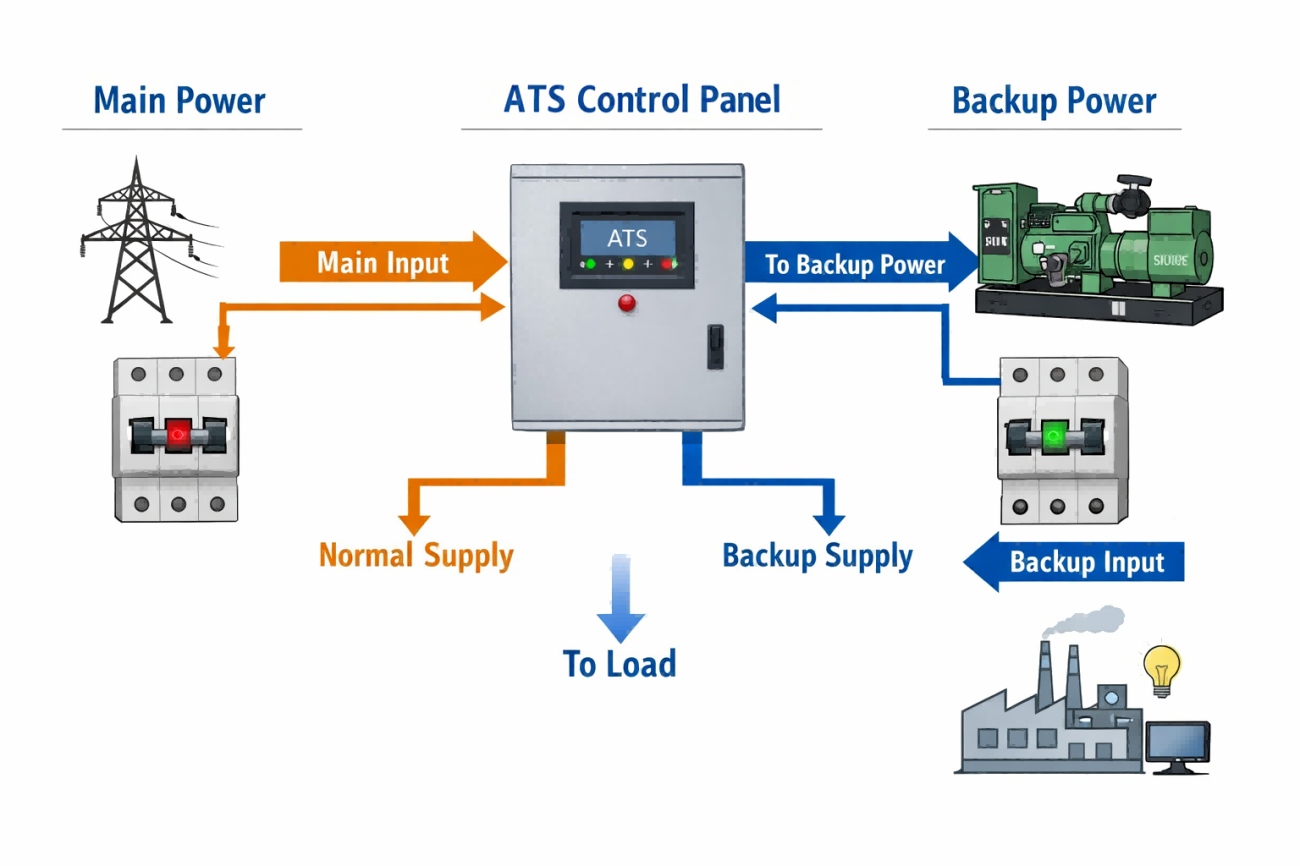

The working principle of the ATS control panel is to monitor the power sources and automatically transfer the load to maintain a continuous and reliable power supply. Understanding how this process works helps users better manage the backup power system and improve overall operational reliability.
During normal operation, the ATS control panel continuously monitors the main power source. As long as these parameters remain within the safe range, the system connects the load to the main power source. It also maintains communication with the backup power source to ensure that the backup power source is ready to start at any time.
Once the main power source experiences problems such as a power outage or voltage sag, the ATS control panel detects the fault signal. After confirming that the abnormality has lasted for a short period (to prevent false judgment), the control system initiates the transfer sequence, and the backup power source starts supplying power.
When the main power source returns to stability (usually after waiting a short period to confirm stability), the ATS control panel performs a reverse transfer, reconnecting the load to the main power source, and the backup power source stops operating and returns to a standby state.
Throughout this process, the ATS control panel relies on internal preset control logic to coordinate each step. Through continuous monitoring and orderly transfer, it ensures that the system operates smoothly and reliably during both fault and power restoration conditions.