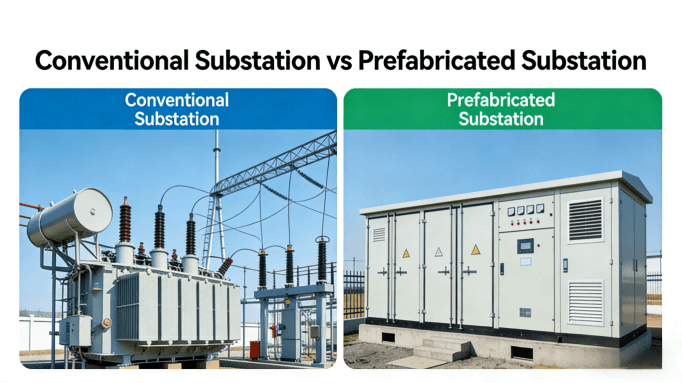

In today’s power system construction, traditional substations and prefabricated substations are the two most commonly used construction methods. They differ significantly in terms of construction method, installation time, space occupation, and application scenarios.
1. Construction method
The construction of a traditional substation generally involves on‑site preparation first, followed by transporting equipment such as transformers, low‑voltage switchgear, and medium‑voltage switchgear to the site one by one for installation.
For a prefabricated substation, all components—such as the transformer, low‑voltage switchgear, and medium‑voltage switchgear—are assembled at the factory, then transported as a complete unit to the site, where only simple installation and commissioning are required.
2. Construction time
Traditional substations require extensive on‑site construction work and step‑by‑step installation of various equipment, taking a relatively long time.
Prefabricated substations use a modular production approach, with most assembly work completed at the factory. Only a small amount of on‑site installation is needed, greatly shortening the on‑site installation time.
3. Space requirement
In a traditional substation, various electrical equipment is placed separately in different areas. To ensure that the equipment does not interfere with each other, allows heat dissipation, and leaves enough maintenance access for workers, such layouts occupy a lot of space.
Prefabricated substations have a compact structure that integrates many functions—such as high‑voltage distribution, transformer, low‑voltage distribution, protection and control, and reactive power compensation—into a single enclosure. Space is used more efficiently, and the required footprint is greatly reduced.
4. Flexibility and scalability
Traditional substations have an open structure, offering greater flexibility for future capacity expansion or equipment upgrades, and are easier to work on.
Prefabricated substations are more suitable for projects that require standardized construction and fast commissioning, but large‑scale capacity expansion may be somewhat constrained.
5. Typical applications
Traditional substations are more suitable for large power grids and high‑voltage transmission systems, while prefabricated substations are particularly well‑suited for urban distribution networks, industrial parks, and projects that require rapid construction and fast commissioning.