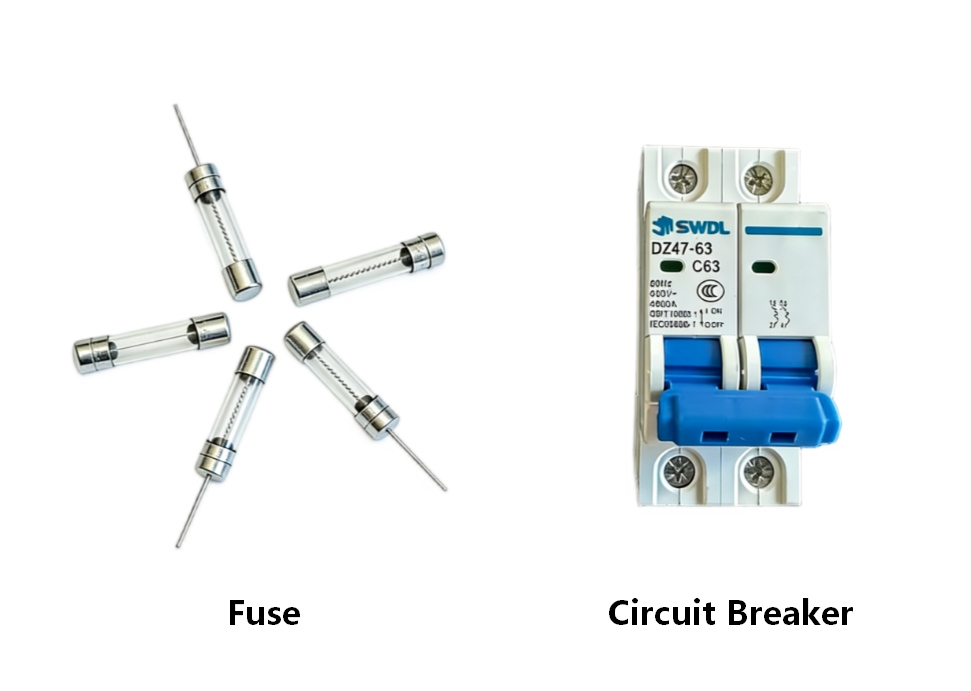

A circuit breaker and a fuse are protection devices designed to cut off fault current, but they differ in operation and performance.
1. Working principle
A circuit breaker disconnects the circuit through a mechanical switch. When an overload or short circuit is detected, the internal tripping device automatically trips and cuts off the current. After the fault is cleared, it can be reset manually or automatically to resume normal operation.
A fuse relies on an internal metal fuse wire to work. When the current is too high, the fuse wire melts due to excessive temperature, thereby disconnecting the circuit. After the fuse wire melts, a new fuse must be installed.
2. Reusability
A circuit breaker, after the fault is cleared, can be reused after resetting, making it especially suitable for applications that require continuous operation.
Once a fuse melts, it must be replaced before it can be used again.
3. Protection performance
A circuit breaker can provide both overload protection and short circuit protection.
A fuse has a fast response speed but a relatively narrower protection range, mainly targeting short circuits.
4. Installation and physical characteristics
A circuit breaker is larger in size, with internal mechanical structures and protection mechanisms, taking up more space, but it offers stronger control capability and safety.
A fuse has a simple structure, a small size, and can be directly connected in series in the circuit, taking up almost no space.
5. Cost and typical applications
A circuit breaker has a higher upfront cost, but because it can be used repeatedly, the long‑term cost is actually not high.
A fuse has a lower upfront cost, but because it needs to be replaced with a new one every time it melts, the maintenance cost increases over time.